Christmas Games for Family: What Works When the Ages Range From Preschoolers to Grandparents
Pick family Christmas games by who can take part, not by which game is most fun. A child who cannot read yet, a grandparent who struggles to hear across a noisy room and an uncle who only wants to watch all need different roles. The table below matches each of them to a game, and every game runs on one phone or a printed sheet.
Who can play what
| Who | Charades | Imposter | Who's most likely to |
|---|---|---|---|
| Children who cannot read yet | Yes, as the guesser: the team sees the word, the child guesses | Only paired with a reader, as a two-person player | Yes, by pointing, with an adult reading the question |
| Early readers | Yes, with Kids' Classics, Animals or Actions | Yes, with a category they know, such as Animals or Food | Yes |
| Teens and adults | Yes, any category | Yes, classic or undercover | Yes |
| Relatives who hear less well | Yes: in acting-only rounds the only thing to hear is the guess | Harder: clues are spoken. Write each clue on paper instead | Yes: put the question on a TV with Big screen |
| People who would rather watch | Yes, as part of the guessing team | Not really: everyone at the table plays | Yes: pointing is the whole game |
Most likely to is the only one of the three where everyone in the room plays at once, so it is the safest first game when you do not know how the room will go.
Charades: the game that works without reading
In PartyDeck charades the word appears on the phone for the guesser's team. The guesser holds it to their forehead or turns away from the screen, so the guesser never needs to read. That is why it is the best game for the youngest players. Choose categories that act well for children: Kids' Classics (48 words such as Hopscotch, Tag, Hide and seek), Animals (50) and Actions (50). The Christmas category has 48 words written as actions, such as Decorating the tree and Hanging a stocking. Older children manage those well.
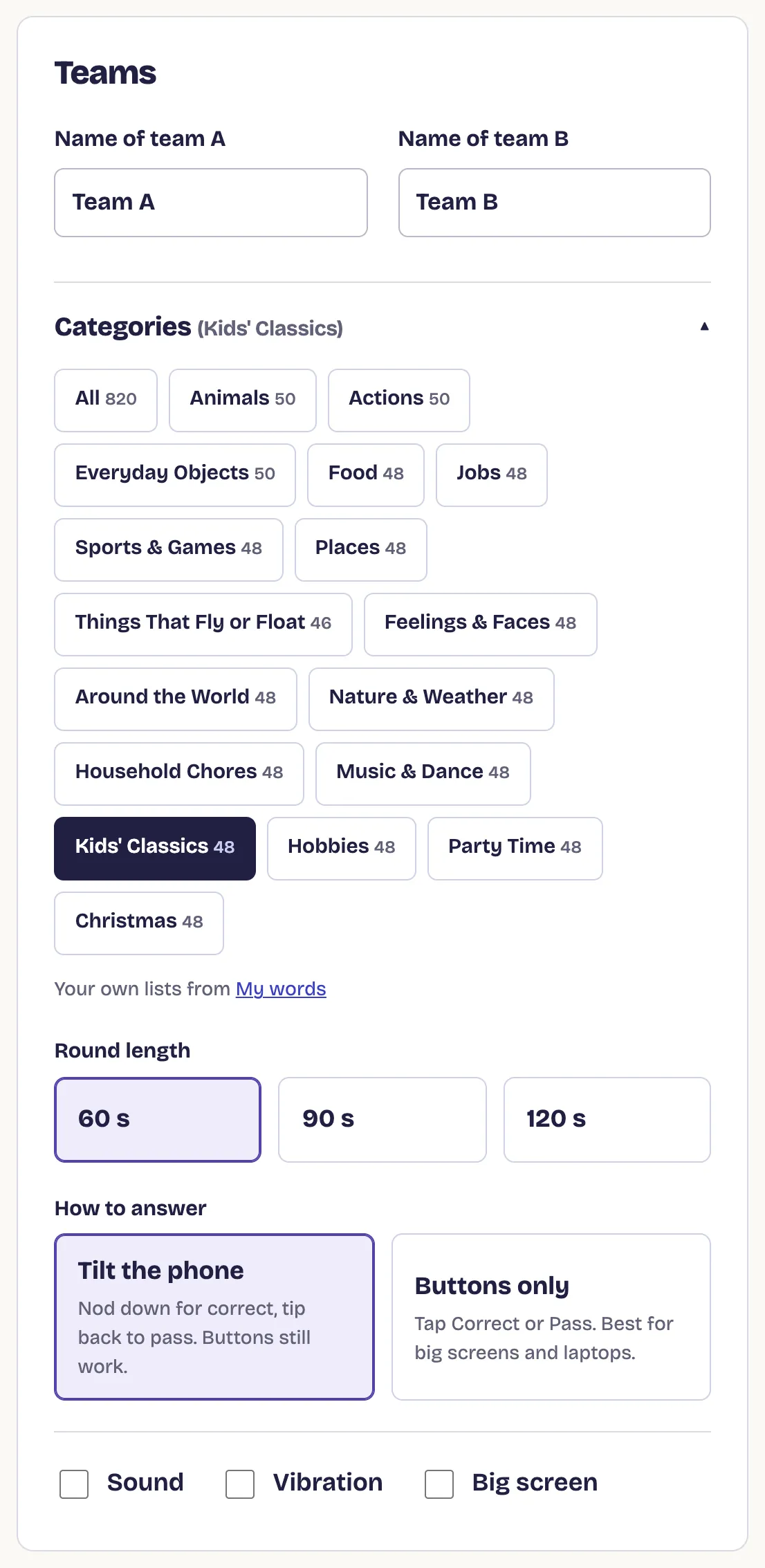
For relatives who hear less well, make the acting team mime only, and let the guessers call out loudly or write their guess on a pad. For the very youngest, let an older cousin act with them as a pair.
Imposter: best with readers, and adjustable for hearing
Imposter needs every player to read their own secret card, so it suits readers. A non-reader can still play as a pair with an older sibling. The game is spoken: each player says one word as a clue. If someone at the table hears less well, have everyone write their clue on paper and show it, and play the discussion with the phone's timer set to 5 minutes or off so nobody is rushed. Choose a category everyone knows: Christmas (44 words), Animals (55) or Food (52).
Who's most likely to: everyone plays at once
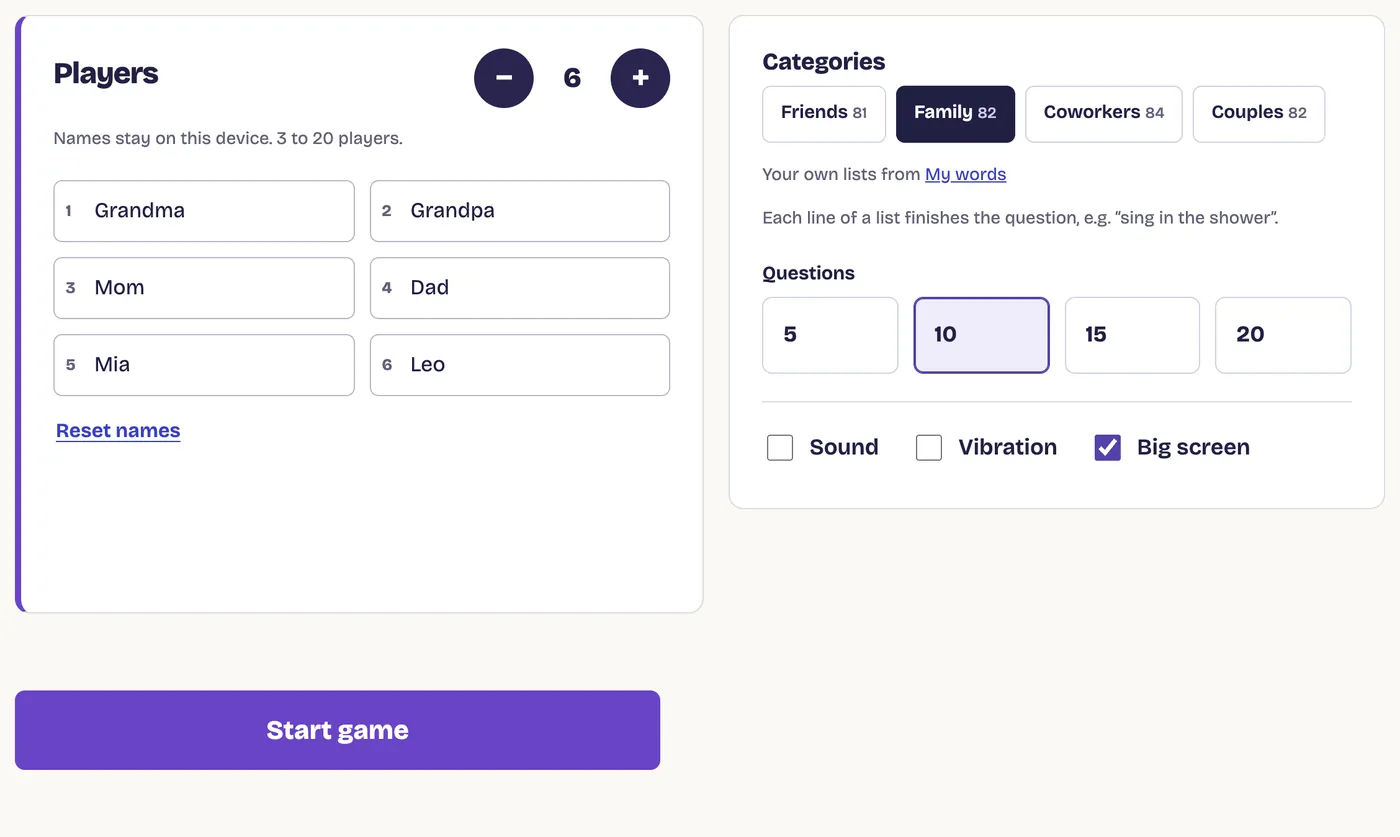
This is the game for the whole sofa at once. The Family set has 82 questions, such as "Who's most likely to tell the same family story every holiday?" and "Who's most likely to start decorating for the holidays way too early?". With Big screen on and the phone mirrored to a TV, people who hear less well can read the question too.
A Christmas afternoon, in order
- Most likely to, Family set, 10 questions. Everyone plays from the sofa.
- Charades, two mixed-age teams. Put a grandparent and a child on each team. Start with Kids' Classics, then switch to Christmas.
- Imposter for the readers, after the youngest have gone off to play. Use the Christmas category, with undercover mode if the group is keen.
No phone at the table? The printable charades cards have kids, family and Christmas sheets of 48 cards each.
Next steps
- All three games with Christmas cards: Christmas party games for one phone.
- Family names and in-jokes as cards: make a list on My words.
- A hunt around the house before the presents: six Christmas scavenger hunt formats on Hunt Cards.